

9,3 customer rating
563 reviews
100% independent
we compare all suppliers
Lowest price guarantee
cheaper than the supplier
Electricity price per kWh
The average electricity price today is €0.32 per kWh. View the changes in the electricity price over the past few weeks here.
Who has the lowest electricity rate in September 2026?
The cheapest kWh price is €0.27 per kWh, from Vandebron. View the kWh prices of all energy suppliers in the overview below.
| Supplier | per kWh | |
|---|---|---|
| Vandebron | € 0.27 | View |
| Energiedirect | € 0.27 | View |
| Delta | € 0.27 | View |
| Greenchoice | € 0.27 | View |
| Budget Thuis | € 0.27 | View |
| ENGIE | € 0.28 | View |
| Oxxio | € 0.28 | View |
| Eneco | € 0.28 | View |
| UnitedConsumers | € 0.28 | View |
Last updated on
09/18/2026.
Prices based on average energy usage with electricity only (2500 kWh) and grid operator costs from Stedin.
Electricity Price Trends
In September 2026, you are currently paying an average of between €0.24 and €0.28 per kWh for electricity.
Why has electricity become so expensive?
Although the kWh price is now lower than the record high in 2022 (€0.90 per kWh), electricity in 2026 is still slightly more expensive than the average electricity costs that applied before the energy crisis (€0.22 per kWh). This is clearly reflected in the electricity price graph for recent years.
This is primarily due to supply and demand, developments in the energy market, and the fact that the electricity price is (still) linked to the gas price in Europe.
The gas price is directly linked to geopolitical developments around the world, such as wars and conflicts, as well as supply agreements between countries.
But the weather and a sharp increase in electricity demand due to growing economies also affect the electricity price.
Comparing energy suppliers based on the lowest electricity price therefore remains important for your energy bill.
 306
reviews
306
reviews
 257
reviews
257
reviews



How much does 1 kWh cost?
With a fixed-rate contract, you currently pay between €0.24 and €0.28 per kWh, including tax.
With a dynamic energy contract, the kWh price changes every hour, but the rate is usually lower than fixed electricity rates. You currently pay between €0.24 and €0.20 per kWh, including tax, with a dynamic contract.
This determines the price per kWh
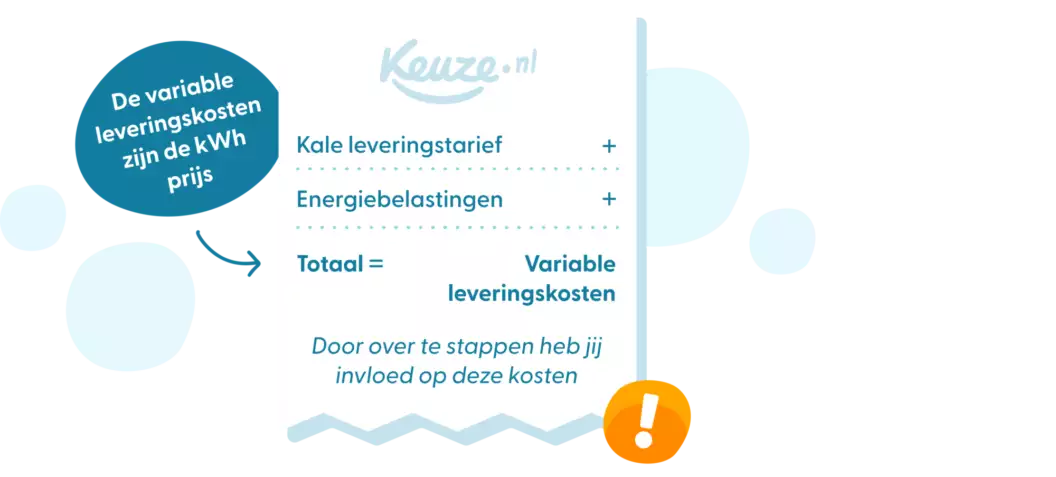
The price per kWh that you pay as a consumer is also referred to as the “variable supply cost” for electricity. These kWh rates vary by supplier, so you have a direct influence on them through your choice of energy contract.
The kWh price consists of:
- 'Base' supply rate per kWh
- €0.123 tax per kWh in 2025
The tax on electricity is the same for every household and every supplier. The base supply rate, on the other hand, is set by the suppliers themselves under the supervision of the ACM. That is why the variable kWh prices differ by supplier. You currently pay the lowest kWh price with a dynamic energy contract.
Previously, you also paid ODE tax for every kWh of electricity. Since 2023, the ODE no longer exists; it has been merged with the energy tax.
Other electricity costs you pay in addition to the kWh price:
- Fixed supply costs
- Grid
operator costs
The fixed supply costs are “administrative costs” and a fixed amount per month. This amount is the same for all suppliers as the fixed supply costs for gas. You pay this amount monthly, and it averages around €6 to €10 per month with a fixed-rate energy contract. With a dynamic energy contract, you pay between €5 and €7 in fixed supply costs per month.
Your supplier pays the grid operator costs for electricity to your grid operator. You pay these costs for the maintenance and expansion of the electricity grid, as well as for the transmission of electricity.
In 2026, grid operator costs for electricity will increase by about €60 per year compared to last year. This was necessary to expand the capacity of the electricity grid and prevent temporary outages.
Why does the price of natural gas affect the price of electricity?
The reason electricity prices are linked to gas prices stems from how the European electricity market operates. In Europe, the purchase price per kWh that energy suppliers pay depends directly on the technology required at any given moment to meet electricity demand.
Solar and wind power are relatively cheap. But if power plants have to step in to meet electricity demand, the price of electricity goes up. This is because gas is needed to generate electricity via power plants. The costs of running the gas plant are then passed on in the price of electricity.
The rule of thumb is therefore: the less gas needed to generate electricity at a given moment, the lower the electricity price.
New EU rules for a stable electricity price per kWh
The fact that the gas price in Europe is currently linked to the electricity price is likely to change in the future. An EU agreement has been reached to decouple the electricity price from the gas price, in order to ensure a stable, lower electricity price.
This is intended to prevent electricity prices from skyrocketing again, as they did during the energy crisis when gas prices rose sharply.
How electricity pricing works with single and dual meters
If you have a single energy meter at home, you pay a single electricity rate throughout the day. If you have a dual energy meter at home, you pay two different electricity rates: a peak rate and an off-peak rate, depending on the time of day.
During peak hours in the evening and morning, you generally pay a higher electricity rate than during off-peak hours at night and on weekends. On holidays, you usually pay an off-peak rate if you choose to have your electricity costs billed using a dual meter.
Electricity costs with a dual meter are often not cheaper
Even with a dual meter, you can still choose to pay a single rate with most suppliers. To do this, you’ll need to contact your supplier directly.
Often, a single meter where you pay a “standard rate” is actually more cost-effective than a dual meter. The price difference has become significantly smaller than it was a few years ago.
A dual meter system can still be more cost-effective if you consume significantly more electricity on weekends and at night. However, the price difference between a single and dual meter is often minimal, and a standard rate is usually cheaper if you consume most of your electricity during the day.