
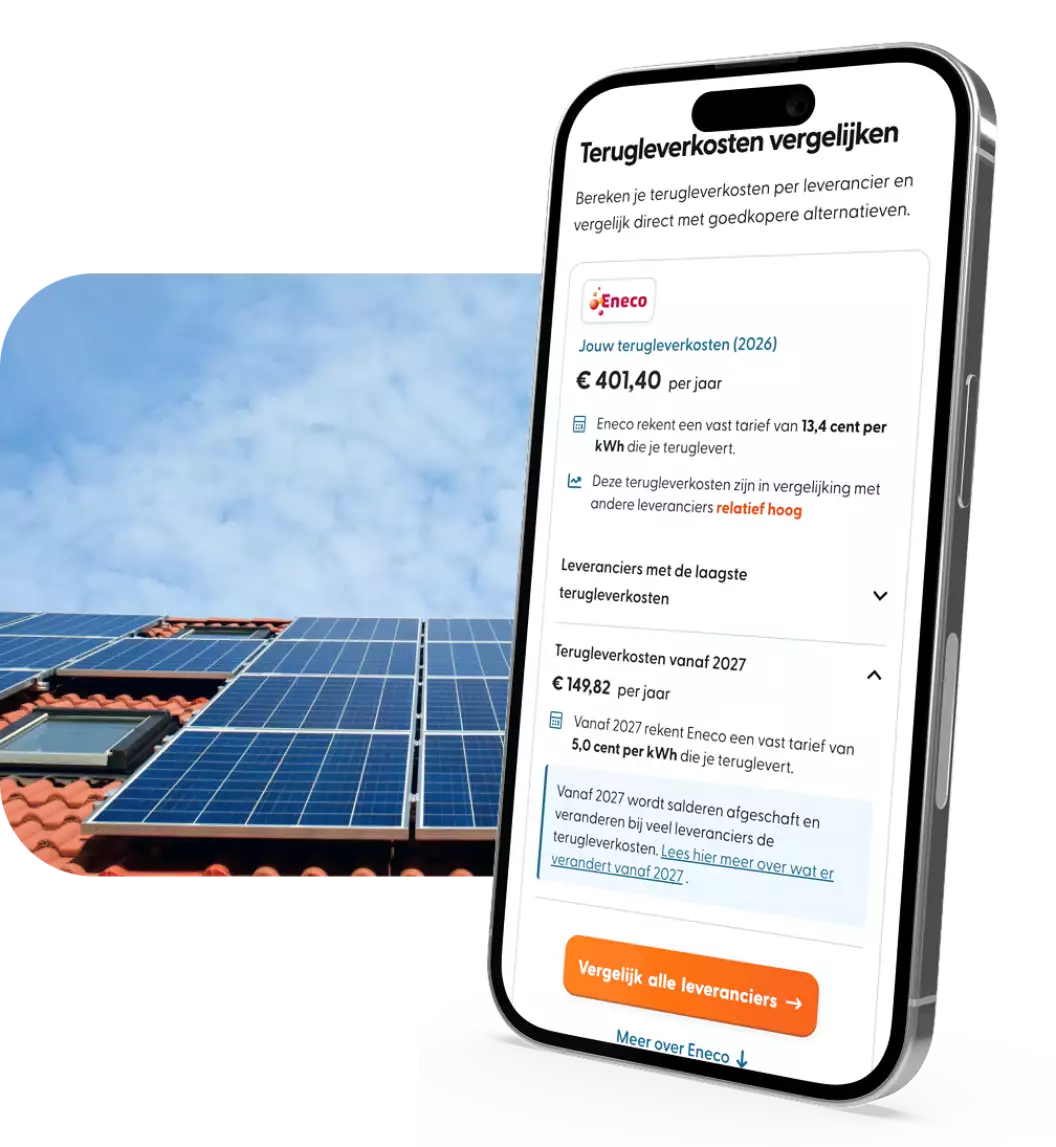
Calculate your feed-in costs
Enter how much electricity you feed back to the grid per year (not the total amount you generate).
Your feed-in costs (2026)
€ -,--
per year
Enter your feed-in amount and supplier to calculate your feed-in costs.
Feed-in Costs: Here’s the Real Story
Our energy expert explains
Feed-in costs are fees your energy supplier charges for the electricity your solar panels feed back into the grid. You pay these fees because suppliers incur costs for processing that fed-back electricity. The more electricity you feed back, the higher those charges. Electricity that you use directly yourself doesn’t count toward these fees.
Look at your total annual cost—not just the feed-in costs
"Of course, you want the lowest possible feed-in costs, but don’t get too fixated on them. Standby fees, supply rates, and sign-up discounts often make up the largest portion of your energy bill. A contract with higher feed-in costs can still be cheaper overall. My advice is therefore: when comparing solar panels, always look at the total annual cost,” says Geert Wirken, energy expert at Keuze.nl.

Feed-in Costs Starting in 2027
Here’s what’s changing for feed-in
Feed-in costs will decrease
Feed-in costs will remain in place, but will be lower for all suppliers starting in 2027. This is because net metering will end and feed-in will be billed differently.
The new rates have already been announced by some suppliers and are reflected in our energy comparison tool.
Feed-in Costs Now Calculated per kWh
Starting in 2027, all suppliers will calculate feed-in costs per kWh instead of using feed-in scales or tiers. This makes comparing rates easier and fairer.
Suppliers will announce their new feed-in costs per kWh in phases over the coming period.
Your returns will decrease
Solar panels will continue to provide benefits, but your profits will decrease starting in 2027: you’ll receive a lower feed-in tariff and will no longer get a refund on energy tax and sales tax for the electricity you feed back into the grid.
So it’s important to use your solar power yourself more often.
Frequently Asked Questions About Feed-in Costs
What are feed-in costs?
Feed-in costs are an additional amount that energy suppliers charge if you have solar panels and feed electricity back into the grid, after net metering. You pay this on top of your regular energy bills.
Why am I being charged feed-in costs?
Energy suppliers incur additional costs due to customers with solar panels who feed electricity back into the grid. These costs stem from the following:
1. Net metering creates a price difference (until 2027)
Net metering allows you to offset the electricity you feed back into the grid in the summer against the electricity you consume in the winter. However, electricity is often cheap during the day in the summer (high supply) and expensive in the winter and at night (low supply). Your supplier can often only sell your solar power at low prices, but later has to purchase expensive electricity to supply you. That difference costs money.
2. The average purchase price is higher
Solar panel customers consume less electricity during cheap daytime hours in the spring and summer, and more during expensive hours in the evening and winter. As a result, the average purchase price per customer rises.
3. Imbalance costs due to unpredictability
The amount of solar power you generate depends on the weather and can change quickly. If the forecast is inaccurate—for example, because it suddenly becomes cloudy—the supplier must make last-minute adjustments by buying or selling electricity. This is done at imbalance prices and results in additional costs.
Why will feed-in costs continue to exist starting in 2027?
Even without net metering, you’ll often feed electricity back into the grid on sunny days. As a result, just as they do now, suppliers incur additional costs to balance supply and demand on the power grid and to process your feed-in. Suppliers pass on these actual costs to you.
Are suppliers allowed to charge fees for feed-in costs?
Yes, they are allowed to do so provided that the fees are “reasonable,” are based on actual costs, and are clearly agreed upon in advance in the terms and conditions.
The Netherlands Authority for Consumers and Markets has conducted several investigations into the reasonableness of feed-in costs. These investigations have shown that none of the suppliers are currently charging “unreasonable” feed-in costs.
Starting in 2027, suppliers will only be allowed to continue charging feed-in costs if they do so to cover their expenses related to customers with solar panels.
When do I pay feed-in costs?
You pay feed-in costs on the portion of your solar power that you don’t consume immediately but feed back into the grid (often around 70%).
Solar power is first directed to your own appliances. If you’re using less than you’re generating at that moment, the surplus is fed into the grid, and your supplier charges you feed-in costs for that portion.
For example: your solar panels generate a total of 3,500 kWh per year, of which you manage to consume 1,000 kWh yourself. That means you feed 2,500 kWh back into the grid that year. You pay feed-in costs on those 2,500 kWh.
How much do I pay in feed-in costs?
That depends entirely on your solar panel system and electricity consumption. The more of the electricity you generate that you can consume directly, the lower your feed-in costs will be.
Assuming you have (modern) solar panels with a capacity of 400 Wp and that you feed back about 70% of your generated electricity each year, you’ll pay the following average annual feed-in costs:
| Feed-in Tariff | Through 2026 | Starting in 2027 |
|---|---|---|
| 2,800 kWh (10 panels) | €375.04 | €188.74 |
| 3,360 kWh (12 panels) | €444.82 | €241.49 |
How are feed-in costs calculated?
Until the end of 2026, feed-in costs will be calculated in two ways, depending on the supplier:
- Through feed-in rate tiers (fixed costs per tier)
- Per kWh fed back
Starting in 2027, all suppliers will switch to feed-in costs per kWh, allowing you to compare feed-in costs more fairly on a one-to-one basis.
The problem with tiers is that your costs can suddenly jump up or down if you just happen to fall into a higher or lower tier. It doesn’t take much of a change in your feed-in to cause this. With the kWh method, you simply pay for each kWh of feed-in, so the costs fluctuate much more evenly. That’s why it’s currently difficult to compare these methods fairly.
Is there a cap on feed-in costs?
There is no maximum rate for feed-in costs, but a supplier is not allowed to make a profit on them. An energy supplier is therefore not allowed to charge extremely high feed-in costs. The regulator (ACM) oversees this.
Can feed-in costs be higher than the compensation?
Yes, that's possible. This is the case with:
- Innova Energie
- Gewoon Energie
- Mega
With these suppliers, you pay a net negative feed-in tariff because the feed-in costs exceed the feed-in tariff.
What if I feed more or less electricity back into the grid than expected?
You only pay feed-in costs for the amount of energy you actually fed back into the grid. This is settled with your energy bill at the end of the year.
Did you feed back less electricity than estimated during an energy year? If so, your feed-in may fall into a lower tier, meaning you’ll pay lower feed-in costs. Did you feed back more electricity than estimated? If so, you’ll pay higher feed-in costs on your energy bill retroactively.
Sometimes, there are also feed-in costs with dynamic contracts
Dynamic energy suppliers love to advertise this: you don’t pay any feed-in costs with them. That’s often true, but not always.
With some dynamic suppliers, you actually pay hidden feed-in costs under the name “export fee.” This is an amount deducted from the market price at the time of feed-in.
So it’s not wise to blindly trust the claim “no feed-in costs”: with a dynamic energy contract, you may still pay feed-in costs, even if they’re usually lower.
Dynamic suppliers without an export fee:
- Zonneplan
- Frank Energie
Read more about dynamic suppliers with feed-in costs.
Good to know: Even without an export fee, a dynamic plan isn’t always cheaper if you feed a lot of power back into the grid. When there are many hours of sunshine, the electricity price is often low, which means a fixed-rate contract with feed-in costs can sometimes be more cost-effective.
You can see this immediately in our energy comparison tool: with the dynamic calculation, we factor in all feed-in costs, as well as any export fee and a lower average market price.

Geert Wirken
Energy expert
How to Reduce Your Feed-in Costs
4 tips from our energy expert
Energy expert Geert Wirken: “Try to minimize your feed-in costs by first using more of the solar power you generate directly with the appliances you already own. Only then should you consider investments such as an air conditioner or a home battery. Whether that’s cost-effective depends on your situation and budget.”
1. Use as much of the electricity you generate as possible right away
The more electricity you use yourself right away, the less you feed back into the grid, and the lower your feed-in costs will be. So plan smart and run your biggest energy-hungry appliances during daylight hours (often between 11:00 a.m. and 3:00 p.m.): washing machine, dryer, dishwasher, and heat pump. This will quickly increase your own consumption by a few percent.
Good to know: don’t turn everything on at once. Appliances like washing machines use a lot of electricity, especially at the start. By spacing out when you turn on your appliances, your consumption will better match what your panels are generating at that moment. This way, you’ll avoid having to feed power back into the grid after all.
2. Charge your electric car at home during the day
Do you own (or plan to own) an electric car? If so, investing in a home charging station can make a significant difference in your feed-in costs. If you consistently charge your electric car at home during the day, you can increase your direct consumption by up to 30%.
3. Buy an air conditioner to cool your home
To make the temperature in your home more comfortable during the hottest days of the year, it’s a good idea to purchase an air conditioner in combination with solar panels.
When your solar panels are generating plenty of electricity during the day between 12:00 and 15:00, you can run your air conditioner on free electricity and improve the climate in your home.
4. Consider a home battery (starting in 2027)
If you’re unable to use more of your solar power directly, or if you don’t want to pay any feed-in costs at all, a home battery could become an attractive option starting in 2027, when the net metering program ends and self-consumption becomes even more important.
A small-scale study conducted by Vereniging Eigen Huis in 2026 shows that a small home battery (up to 10 kWh of storage) can significantly increase direct consumption by as much as 30%.
Just be aware that it’s currently still difficult to recoup the cost of a home battery within a reasonable timeframe, because the revenue models (such as trading on the imbalance market) are still very uncertain.

Feed-in costs per energy supplier
These are the feed-in costs of all energy suppliers in the Netherlands:
Budget Thuis
Budget Thuis still uses tiered feed-in costs in 2026. The tier is determined by the total amount of electricity you feed back to the grid per year, and you pay a fixed amount for that.
Budget Thuis feed-in costs from 2027:This changes from 2027: from then on, Budget Thuis will charge 5,3 cents per kWh feed-in costs on all electricity you feed back to the grid.
With Budget Thuis, you pay the following feed-in costs for solar panels:
| Tier | Feed-in | Feed-in costs 2026* | Feed-in costs 2027 |
|---|---|---|---|
| 1 . | up to 4 kWh | — | € 0,21 p/y |
| 2 . | 5 - 499 kWh | € 24,00 p/y | € 13,23 p/y |
| 3 . | 500 - 999 kWh | € 72,00 p/y | € 39,35 p/y |
| 4 . | 1.000 - 1.499 kWh | € 120,00 p/y | € 65,60 p/y |
| 5 . | 1.500 - 1.999 kWh | € 168,00 p/y | € 91,85 p/y |
| 6 . | 2.000 - 2.499 kWh | € 216,00 p/y | € 118,10 p/y |
| 7 . | 2.500 - 2.999 kWh | € 258,00 p/y | € 144,35 p/y |
| 8 . | 3.000 - 3.499 kWh | € 318,00 p/y | € 170,60 p/y |
| 9 . | 3.500 - 3.999 kWh | € 378,00 p/y | € 196,85 p/y |
| 10 . | 4.000 - 4.499 kWh | € 438,00 p/y | € 223,10 p/y |
| 11 . | 4.500 - 4.999 kWh | € 504,00 p/y | € 249,35 p/y |
| 12 . | 5.000 - 5.499 kWh | € 672,00 p/y | € 275,60 p/y |
| 13 . | 5.500 - 5.999 kWh | € 732,00 p/y | € 301,85 p/y |
| 14 . | 6.000 - 6.499 kWh | € 804,00 p/y | € 328,10 p/y |
| 15 . | 6.500 - 6.999 kWh | € 864,00 p/y | € 354,35 p/y |
| 16 . | 7.000 - 7.499 kWh | € 930,00 p/y | € 380,60 p/y |
| 17 . | 7.500 - 7.999 kWh | € 996,00 p/y | € 406,85 p/y |
| 18 . | 8.000 - 8.499 kWh | € 1.080,00 p/y | € 433,10 p/y |
| 19 . | 8.500 - 8.999 kWh | € 1.128,00 p/y | € 459,35 p/y |
| 20 . | 9.000 - 9.499 kWh | € 1.188,00 p/y | € 485,60 p/y |
| 21 . | 9.500 - 9.999 kWh | € 1.236,00 p/y | € 511,85 p/y |
| 22 . | 10.000 - 12.499 kWh | € 1.416,00 p/y | € 590,60 p/y |
| 23 . | 12.500 - 14.999 kWh | € 1.764,00 p/y | € 721,85 p/y |
| 24 . | 15.000 - 17.499 kWh | € 2.076,00 p/y | € 853,10 p/y |
| 25 . | 17.500 - 19.999 kWh | € 2.370,00 p/y | € 984,35 p/y |
| 26 . | 20.000 - 40.000 kWh | € 2.820,00 p/y | € 1.575,00 p/y |
Feed-in costs of Budget Thuis per tier in 2026
and average feed-in per tier for 2027.
* Calculated on the electricity you net meter (per year).
For electricity you feed back to the grid beyond your net metering, you pay no feed-in costs with Budget Thuis.
Coolblue Energie
Coolblue Energie charges 11,5 cents per kWh feed-in costs on all electricity you feed back to the grid.
Coolblue Energie feed-in costs from 2027:These costs change in 2027. From then on, Coolblue Energie will charge 7,3 cents per kWh feed-in costs on all electricity you feed back to the grid.
This table shows the feed-in costs with Coolblue Energie for different amounts of electricity fed back to the grid:
| Feed-in | Feed-in costs 2026 | Feed-in costs 2027 |
|---|---|---|
| 2.500 kWh | € 287,38 p/y | € 181,50 p/y |
| 3.000 kWh | € 344,85 p/y | € 217,80 p/y |
| 4.000 kWh | € 459,80 p/y | € 290,40 p/y |
| 5.000 kWh | € 574,75 p/y | € 363,00 p/y |
| 9.000 kWh | € 1.034,55 p/y | € 653,40 p/y |
Feed-in costs of Coolblue Energie in 2026 and 2027 for different amounts of electricity fed back to the grid. Costs are calculated per kWh of electricity fed back to the grid.
Delta Energie
Delta Energie still uses tiered feed-in costs in 2026. The tier is determined by the total amount of electricity you feed back to the grid per year, and you pay a fixed amount for that.
Delta Energie feed-in costs from 2027:This changes from 2027: from then on, Delta Energie will charge 5,7 cents per kWh feed-in costs on all electricity you feed back to the grid.
With Delta Energie, you pay the following feed-in costs for solar panels:
| Tier | Feed-in | Feed-in costs 2026* | Feed-in costs 2027 |
|---|---|---|---|
| 1 . | up to 99 kWh | — | € 5,60 p/y |
| 2 . | 100 - 199 kWh | € 21,30 p/y | € 8,46 p/y |
| 3 . | 200 - 299 kWh | € 35,50 p/y | € 14,12 p/y |
| 4 . | 300 - 399 kWh | € 49,60 p/y | € 19,78 p/y |
| 5 . | 400 - 499 kWh | € 63,90 p/y | € 25,44 p/y |
| 6 . | 500 - 599 kWh | € 78,00 p/y | € 31,10 p/y |
| 7 . | 600 - 699 kWh | € 92,30 p/y | € 36,76 p/y |
| 8 . | 700 - 799 kWh | € 106,50 p/y | € 42,41 p/y |
| 9 . | 800 - 899 kWh | € 120,70 p/y | € 48,07 p/y |
| 10 . | 900 - 999 kWh | € 135,00 p/y | € 53,73 p/y |
| 11 . | 1.000 - 1.099 kWh | € 149,10 p/y | € 59,39 p/y |
| 12 . | 1.100 - 1.199 kWh | € 163,40 p/y | € 65,05 p/y |
| 13 . | 1.200 - 1.299 kWh | € 177,60 p/y | € 70,71 p/y |
| 14 . | 1.300 - 1.399 kWh | € 191,80 p/y | € 76,37 p/y |
| 15 . | 1.400 - 1.499 kWh | € 206,00 p/y | € 82,03 p/y |
| 16 . | 1.500 - 1.599 kWh | € 220,20 p/y | € 87,69 p/y |
| 17 . | 1.600 - 1.699 kWh | € 234,40 p/y | € 93,35 p/y |
| 18 . | 1.700 - 1.799 kWh | € 248,70 p/y | € 99,00 p/y |
| 19 . | 1.800 - 1.899 kWh | € 262,80 p/y | € 104,66 p/y |
| 20 . | 1.900 - 1.999 kWh | € 277,10 p/y | € 110,32 p/y |
| 21 . | 2.000 - 2.199 kWh | € 298,30 p/y | € 118,81 p/y |
| 22 . | 2.200 - 2.399 kWh | € 326,70 p/y | € 130,13 p/y |
| 23 . | 2.400 - 2.599 kWh | € 355,20 p/y | € 141,45 p/y |
| 24 . | 2.600 - 2.799 kWh | € 383,70 p/y | € 152,76 p/y |
| 25 . | 2.800 - 2.999 kWh | € 412,10 p/y | € 164,08 p/y |
| 26 . | 3.000 - 3.299 kWh | € 447,60 p/y | € 178,23 p/y |
| 27 . | 3.300 - 3.599 kWh | € 490,10 p/y | € 195,21 p/y |
| 28 . | 3.600 - 3.999 kWh | € 539,90 p/y | € 215,01 p/y |
| 29 . | 4.000 - 4.499 kWh | € 603,80 p/y | € 240,48 p/y |
| 30 . | 4.500 - 4.999 kWh | € 674,80 p/y | € 268,77 p/y |
| 31 . | 5.000 - 5.999 kWh | € 781,30 p/y | € 311,22 p/y |
| 32 . | 6.000 - 7.499 kWh | € 958,90 p/y | € 381,95 p/y |
| 33 . | 7.500 - 9.999 kWh | € 1.237,00 p/y | € 495,13 p/y |
| 34 . | 10.000 - 12.499 kWh | € 1.598,20 p/y | € 636,61 p/y |
| 35 . | 12.500 - 14.999 kWh | € 1.953,30 p/y | € 778,08 p/y |
| 36 . | 15.000 - 19.999 kWh | € 2.474,60 p/y | € 990,30 p/y |
| 37 . | 20.000 - 24.999 kWh | € 3.196,40 p/y | € 1.273,25 p/y |
| 38 . | 25.000 - 29.999 kWh | € 3.906,70 p/y | € 1.556,20 p/y |
| 39 . | 30.000 - 39.999 kWh | € 4.949,60 p/y | € 1.980,62 p/y |
| 40 . | 40.000 - 49.999 kWh | € 6.392,90 p/y | € 2.546,52 p/y |
| 41 . | 50.000 - 59.999 kWh | € 7.813,50 p/y | € 3.112,42 p/y |
| 42 . | 60.000 - 69.999 kWh | € 9.234,10 p/y | € 3.678,32 p/y |
| 43 . | 70.000 - 79.999 kWh | € 10.654,70 p/y | € 4.244,22 p/y |
| 44 . | 80.000 - 89.999 kWh | € 12.075,20 p/y | € 4.810,12 p/y |
| 45 . | 90.000 - 999.999 kWh | € 13.495,80 p/y | € 30.841,52 p/y |
Feed-in costs of Delta Energie per tier in 2026
and average feed-in per tier for 2027.
* Calculated on all electricity fed back to the grid (per year)
Eneco
Eneco charges 14,1 cents per kWh feed-in costs on all electricity you feed back to the grid.
Eneco feed-in costs from 2027:These costs change in 2027. From then on, Eneco will charge 4,5 cents per kWh feed-in costs on all electricity you feed back to the grid.
This table shows the feed-in costs with Eneco for different amounts of electricity fed back to the grid:
| Feed-in | Feed-in costs 2026 | Feed-in costs 2027 |
|---|---|---|
| 2.500 kWh | € 352,20 p/y | € 112,63 p/y |
| 3.000 kWh | € 422,64 p/y | € 135,15 p/y |
| 4.000 kWh | € 563,52 p/y | € 180,20 p/y |
| 5.000 kWh | € 704,40 p/y | € 225,25 p/y |
| 9.000 kWh | € 1.267,92 p/y | € 405,45 p/y |
Feed-in costs of Eneco in 2026 and 2027 for different amounts of electricity fed back to the grid. Costs are calculated per kWh of electricity fed back to the grid.
Energiedirect
Energiedirect still uses tiered feed-in costs in 2026. The tier is determined by the total amount of electricity you feed back to the grid per year, and you pay a fixed amount for that.
Energiedirect feed-in costs from 2027:This changes from 2027: from then on, Energiedirect will charge 7,1 cents per kWh feed-in costs on all electricity you feed back to the grid.
With Energiedirect, you pay the following feed-in costs for solar panels:
| Tier | Feed-in | Feed-in costs 2026* | Feed-in costs 2027 |
|---|---|---|---|
| 1 . | 251 - 500 kWh | € 48,84 p/y | € 26,71 p/y |
| 2 . | 501 - 750 kWh | € 81,36 p/y | € 44,50 p/y |
| 3 . | 751 - 1.000 kWh | € 113,64 p/y | € 62,28 p/y |
| 4 . | 1.001 - 1.250 kWh | € 146,16 p/y | € 80,07 p/y |
| 5 . | 1.251 - 1.500 kWh | € 178,80 p/y | € 97,85 p/y |
| 6 . | 1.501 - 1.750 kWh | € 211,32 p/y | € 115,64 p/y |
| 7 . | 1.751 - 2.000 kWh | € 243,84 p/y | € 133,42 p/y |
| 8 . | 2.001 - 2.250 kWh | € 276,36 p/y | € 151,21 p/y |
| 9 . | 2.251 - 2.500 kWh | € 308,76 p/y | € 168,99 p/y |
| 10 . | 2.501 - 2.750 kWh | € 341,28 p/y | € 186,78 p/y |
| 11 . | 2.751 - 3.000 kWh | € 373,80 p/y | € 204,56 p/y |
| 12 . | 3.001 - 3.250 kWh | € 406,32 p/y | € 222,35 p/y |
| 13 . | 3.251 - 3.500 kWh | € 438,84 p/y | € 240,13 p/y |
| 14 . | 3.501 - 3.750 kWh | € 471,36 p/y | € 257,92 p/y |
| 15 . | 3.751 - 4.000 kWh | € 503,76 p/y | € 275,70 p/y |
| 16 . | 4.001 - 4.250 kWh | € 536,28 p/y | € 293,49 p/y |
| 17 . | 4.251 - 4.500 kWh | € 568,80 p/y | € 311,27 p/y |
| 18 . | 4.501 - 4.750 kWh | € 601,32 p/y | € 329,06 p/y |
| 19 . | 4.751 - 5.000 kWh | € 633,84 p/y | € 346,84 p/y |
| 20 . | 5.001 - 5.250 kWh | € 666,12 p/y | € 364,63 p/y |
| 21 . | 5.251 - 5.500 kWh | € 698,76 p/y | € 382,41 p/y |
| 22 . | 5.501 - 5.750 kWh | € 731,28 p/y | € 400,20 p/y |
| 23 . | 5.751 - 6.000 kWh | € 763,80 p/y | € 417,98 p/y |
| 24 . | 6.001 - 6.250 kWh | € 796,32 p/y | € 435,77 p/y |
| 25 . | 6.251 - 6.500 kWh | € 828,84 p/y | € 453,55 p/y |
| 26 . | 6.501 - 6.750 kWh | € 861,24 p/y | € 471,34 p/y |
| 27 . | 6.751 - 7.000 kWh | € 893,76 p/y | € 489,12 p/y |
| 28 . | 7.001 - 7.250 kWh | € 926,28 p/y | € 506,91 p/y |
| 29 . | 7.251 - 7.500 kWh | € 958,80 p/y | € 524,69 p/y |
| 30 . | 7.501 - 7.750 kWh | € 991,32 p/y | € 542,48 p/y |
| 31 . | 7.751 - 8.000 kWh | € 1.023,84 p/y | € 560,26 p/y |
| 32 . | 8.001 - 8.250 kWh | € 1.056,24 p/y | € 578,05 p/y |
| 33 . | 8.251 - 8.500 kWh | € 1.088,76 p/y | € 595,83 p/y |
| 34 . | 8.501 - 8.750 kWh | € 1.121,28 p/y | € 613,62 p/y |
| 35 . | 8.751 - 9.000 kWh | € 1.153,80 p/y | € 631,40 p/y |
| 36 . | 9.001 - 9.250 kWh | € 1.186,32 p/y | € 649,19 p/y |
| 37 . | 9.251 - 9.500 kWh | € 1.218,84 p/y | € 666,97 p/y |
| 38 . | 9.501 - 9.750 kWh | € 1.251,24 p/y | € 684,76 p/y |
| 39 . | 9.751 - 10.000 kWh | € 1.283,76 p/y | € 702,54 p/y |
| 40 . | from 10.001 kWh | € 1.332,48 p/y | € 711,47 p/y |
Feed-in costs of Energiedirect per tier in 2026
and average feed-in per tier for 2027.
* Calculated on all electricity fed back to the grid (per year)
Energiek
Energiek still charges 6,1 cents per kWh feed-in costs on all electricity you feed back to the grid in 2026.
Energiek has not yet published new feed-in costs for 2027. In the energy comparison tool, we use the current feed-in costs.
This table shows the feed-in costs with Energiek for different amounts of electricity fed back to the grid:
| Feed-in | Feed-in costs 2026 |
|---|---|
| 2.500 kWh | € 151,25 p/y |
| 3.000 kWh | € 181,50 p/y |
| 4.000 kWh | € 242,00 p/y |
| 5.000 kWh | € 302,50 p/y |
| 9.000 kWh | € 544,50 p/y |
Feed-in costs of Energiek in 2026 and 2027 for different amounts of electricity fed back to the grid. Costs are calculated per kWh of electricity fed back to the grid.
Engie
Engie charges 14,4 cents per kWh feed-in costs on all electricity you feed back to the grid.
Engie feed-in costs from 2027:These costs change in 2027. From then on, Engie will charge 14,4 cents per kWh feed-in costs on all electricity you feed back to the grid.
This table shows the feed-in costs with Engie for different amounts of electricity fed back to the grid:
| Feed-in | Feed-in costs 2026 | Feed-in costs 2027 |
|---|---|---|
| 2.500 kWh | € 360,03 p/y | € 360,03 p/y |
| 3.000 kWh | € 432,03 p/y | € 432,03 p/y |
| 4.000 kWh | € 576,04 p/y | € 576,04 p/y |
| 5.000 kWh | € 720,05 p/y | € 720,05 p/y |
| 9.000 kWh | € 1.296,09 p/y | € 1.296,09 p/y |
Feed-in costs of Engie in 2026 and 2027 for different amounts of electricity fed back to the grid. Costs are calculated per kWh of electricity fed back to the grid.
Essent
Essent still uses tiered feed-in costs in 2026. The tier is determined by the total amount of electricity you feed back to the grid per year, and you pay a fixed amount for that.
Essent feed-in costs from 2027:This changes from 2027: from then on, Essent will charge 7,8 cents per kWh feed-in costs on all electricity you feed back to the grid.
With Essent, you pay the following feed-in costs for solar panels:
| Tier | Feed-in | Feed-in costs 2026* | Feed-in costs 2027 |
|---|---|---|---|
| 1 . | 251 - 500 kWh | € 48,84 p/y | € 29,38 p/y |
| 2 . | 501 - 750 kWh | € 81,36 p/y | € 48,94 p/y |
| 3 . | 751 - 1.000 kWh | € 113,64 p/y | € 68,50 p/y |
| 4 . | 1.001 - 1.250 kWh | € 146,16 p/y | € 88,06 p/y |
| 5 . | 1.251 - 1.500 kWh | € 178,80 p/y | € 107,62 p/y |
| 6 . | 1.501 - 1.750 kWh | € 211,32 p/y | € 127,18 p/y |
| 7 . | 1.751 - 2.000 kWh | € 243,84 p/y | € 146,74 p/y |
| 8 . | 2.001 - 2.250 kWh | € 276,36 p/y | € 166,30 p/y |
| 9 . | 2.251 - 2.500 kWh | € 308,76 p/y | € 185,86 p/y |
| 10 . | 2.501 - 2.750 kWh | € 341,28 p/y | € 205,42 p/y |
| 11 . | 2.751 - 3.000 kWh | € 373,80 p/y | € 224,98 p/y |
| 12 . | 3.001 - 3.250 kWh | € 406,32 p/y | € 244,54 p/y |
| 13 . | 3.251 - 3.500 kWh | € 438,84 p/y | € 264,10 p/y |
| 14 . | 3.501 - 3.750 kWh | € 471,36 p/y | € 283,66 p/y |
| 15 . | 3.751 - 4.000 kWh | € 503,76 p/y | € 303,22 p/y |
| 16 . | 4.001 - 4.250 kWh | € 536,28 p/y | € 322,78 p/y |
| 17 . | 4.251 - 4.500 kWh | € 568,80 p/y | € 342,34 p/y |
| 18 . | 4.501 - 4.750 kWh | € 601,32 p/y | € 361,90 p/y |
| 19 . | 4.751 - 5.000 kWh | € 633,84 p/y | € 381,46 p/y |
| 20 . | 5.001 - 5.250 kWh | € 666,12 p/y | € 401,02 p/y |
| 21 . | 5.251 - 5.500 kWh | € 698,76 p/y | € 420,58 p/y |
| 22 . | 5.501 - 5.750 kWh | € 731,28 p/y | € 440,14 p/y |
| 23 . | 5.751 - 6.000 kWh | € 763,80 p/y | € 459,70 p/y |
| 24 . | 6.001 - 6.250 kWh | € 796,32 p/y | € 479,26 p/y |
| 25 . | 6.251 - 6.500 kWh | € 828,84 p/y | € 498,82 p/y |
| 26 . | 6.501 - 6.750 kWh | € 861,24 p/y | € 518,38 p/y |
| 27 . | 6.751 - 7.000 kWh | € 893,76 p/y | € 537,94 p/y |
| 28 . | 7.001 - 7.250 kWh | € 926,28 p/y | € 557,50 p/y |
| 29 . | 7.251 - 7.500 kWh | € 958,80 p/y | € 577,06 p/y |
| 30 . | 7.501 - 7.750 kWh | € 991,32 p/y | € 596,62 p/y |
| 31 . | 7.751 - 8.000 kWh | € 1.023,84 p/y | € 616,18 p/y |
| 32 . | 8.001 - 8.250 kWh | € 1.056,24 p/y | € 635,74 p/y |
| 33 . | 8.251 - 8.500 kWh | € 1.088,76 p/y | € 655,30 p/y |
| 34 . | 8.501 - 8.750 kWh | € 1.121,28 p/y | € 674,86 p/y |
| 35 . | 8.751 - 9.000 kWh | € 1.153,80 p/y | € 694,42 p/y |
| 36 . | 9.001 - 9.250 kWh | € 1.186,32 p/y | € 713,98 p/y |
| 37 . | 9.251 - 9.500 kWh | € 1.218,84 p/y | € 733,54 p/y |
| 38 . | 9.501 - 9.750 kWh | € 1.251,24 p/y | € 753,10 p/y |
| 39 . | 9.751 - 10.000 kWh | € 1.283,76 p/y | € 772,66 p/y |
| 40 . | from 10.001 kWh | € 1.332,48 p/y | € 782,48 p/y |
Feed-in costs of Essent per tier in 2026
and average feed-in per tier for 2027.
* Calculated on all electricity fed back to the grid (per year)
Gewoon Energie
Gewoon Energie charges 13,3 cents per kWh feed-in costs on all electricity you feed back to the grid.
Gewoon Energie feed-in costs from 2027:These costs change in 2027. From then on, Gewoon Energie will charge 7,1 cents per kWh feed-in costs on all electricity you feed back to the grid.
This table shows the feed-in costs with Gewoon Energie for different amounts of electricity fed back to the grid:
| Feed-in | Feed-in costs 2026 | Feed-in costs 2027 |
|---|---|---|
| 2.500 kWh | € 332,75 p/y | € 177,03 p/y |
| 3.000 kWh | € 399,30 p/y | € 212,43 p/y |
| 4.000 kWh | € 532,40 p/y | € 283,24 p/y |
| 5.000 kWh | € 665,50 p/y | € 354,05 p/y |
| 9.000 kWh | € 1.197,90 p/y | € 637,29 p/y |
Feed-in costs of Gewoon Energie in 2026 and 2027 for different amounts of electricity fed back to the grid. Costs are calculated per kWh of electricity fed back to the grid.
Greenchoice
Greenchoice charges 13,6 cents per kWh feed-in costs on all electricity you feed back to the grid.
Greenchoice feed-in costs from 2027:These costs change in 2027. From then on, Greenchoice will charge 7,3 cents per kWh feed-in costs on all electricity you feed back to the grid.
This table shows the feed-in costs with Greenchoice for different amounts of electricity fed back to the grid:
| Feed-in | Feed-in costs 2026 | Feed-in costs 2027 |
|---|---|---|
| 2.500 kWh | € 340,33 p/y | € 183,18 p/y |
| 3.000 kWh | € 408,39 p/y | € 219,81 p/y |
| 4.000 kWh | € 544,52 p/y | € 293,08 p/y |
| 5.000 kWh | € 680,65 p/y | € 366,35 p/y |
| 9.000 kWh | € 1.225,17 p/y | € 659,43 p/y |
Feed-in costs of Greenchoice in 2026 and 2027 for different amounts of electricity fed back to the grid. Costs are calculated per kWh of electricity fed back to the grid.
Innova Energie
Innova Energie charges 13,3 cents per kWh feed-in costs on all electricity you feed back to the grid.
Innova Energie feed-in costs from 2027:These costs change in 2027. From then on, Innova Energie will charge 7,4 cents per kWh feed-in costs on all electricity you feed back to the grid.
This table shows the feed-in costs with Innova Energie for different amounts of electricity fed back to the grid:
| Feed-in | Feed-in costs 2026 | Feed-in costs 2027 |
|---|---|---|
| 2.500 kWh | € 332,75 p/y | € 184,98 p/y |
| 3.000 kWh | € 399,30 p/y | € 221,97 p/y |
| 4.000 kWh | € 532,40 p/y | € 295,96 p/y |
| 5.000 kWh | € 665,50 p/y | € 369,95 p/y |
| 9.000 kWh | € 1.197,90 p/y | € 665,91 p/y |
Feed-in costs of Innova Energie in 2026 and 2027 for different amounts of electricity fed back to the grid. Costs are calculated per kWh of electricity fed back to the grid.
Mega
Mega still charges 17,2 cents per kWh feed-in costs on all electricity you feed back to the grid in 2026.
Mega has not yet published new feed-in costs for 2027. In the energy comparison tool, we use the current feed-in costs.
This table shows the feed-in costs with Mega for different amounts of electricity fed back to the grid:
| Feed-in | Feed-in costs 2026 |
|---|---|
| 2.500 kWh | € 429,28 p/y |
| 3.000 kWh | € 515,13 p/y |
| 4.000 kWh | € 686,84 p/y |
| 5.000 kWh | € 858,55 p/y |
| 9.000 kWh | € 1.545,39 p/y |
Feed-in costs of Mega in 2026 and 2027 for different amounts of electricity fed back to the grid. Costs are calculated per kWh of electricity fed back to the grid.
Oxxio
Oxxio charges 14,2 cents per kWh feed-in costs on all electricity you feed back to the grid.
Oxxio feed-in costs from 2027:These costs change in 2027. From then on, Oxxio will charge 4,5 cents per kWh feed-in costs on all electricity you feed back to the grid.
This table shows the feed-in costs with Oxxio for different amounts of electricity fed back to the grid:
| Feed-in | Feed-in costs 2026 | Feed-in costs 2027 |
|---|---|---|
| 2.500 kWh | € 353,90 p/y | € 112,63 p/y |
| 3.000 kWh | € 424,68 p/y | € 135,15 p/y |
| 4.000 kWh | € 566,24 p/y | € 180,20 p/y |
| 5.000 kWh | € 707,80 p/y | € 225,25 p/y |
| 9.000 kWh | € 1.274,04 p/y | € 405,45 p/y |
Feed-in costs of Oxxio in 2026 and 2027 for different amounts of electricity fed back to the grid. Costs are calculated per kWh of electricity fed back to the grid.
Powerpeers
Powerpeers charges 6,5 cents per kWh feed-in costs on all electricity you feed back to the grid.
Powerpeers feed-in costs from 2027:These costs change in 2027. From then on, Powerpeers will charge 6,5 cents per kWh feed-in costs on all electricity you feed back to the grid.
This table shows the feed-in costs with Powerpeers for different amounts of electricity fed back to the grid:
| Feed-in | Feed-in costs 2026 | Feed-in costs 2027 |
|---|---|---|
| 2.500 kWh | € 161,53 p/y | € 161,53 p/y |
| 3.000 kWh | € 193,83 p/y | € 193,83 p/y |
| 4.000 kWh | € 258,44 p/y | € 258,44 p/y |
| 5.000 kWh | € 323,05 p/y | € 323,05 p/y |
| 9.000 kWh | € 581,49 p/y | € 581,49 p/y |
Feed-in costs of Powerpeers in 2026 and 2027 for different amounts of electricity fed back to the grid. Costs are calculated per kWh of electricity fed back to the grid.
Pure Energie
Pure Energie charges 13,9 cents per kWh feed-in costs on all electricity you feed back to the grid.
Pure Energie feed-in costs from 2027:These costs change in 2027. From then on, Pure Energie will charge 8,3 cents per kWh feed-in costs on all electricity you feed back to the grid.
This table shows the feed-in costs with Pure Energie for different amounts of electricity fed back to the grid:
| Feed-in | Feed-in costs 2026 | Feed-in costs 2027 |
|---|---|---|
| 2.500 kWh | € 347,50 p/y | € 206,25 p/y |
| 3.000 kWh | € 417,00 p/y | € 247,50 p/y |
| 4.000 kWh | € 556,00 p/y | € 330,00 p/y |
| 5.000 kWh | € 695,00 p/y | € 412,50 p/y |
| 9.000 kWh | € 1.251,00 p/y | € 742,50 p/y |
Feed-in costs of Pure Energie in 2026 and 2027 for different amounts of electricity fed back to the grid. Costs are calculated per kWh of electricity fed back to the grid.
UnitedConsumers
UnitedConsumers charges 15,4 cents per kWh feed-in costs on all electricity you feed back to the grid.
UnitedConsumers feed-in costs from 2027:These costs change in 2027. From then on, UnitedConsumers will charge 15,4 cents per kWh feed-in costs on all electricity you feed back to the grid.
This table shows the feed-in costs with UnitedConsumers for different amounts of electricity fed back to the grid:
| Feed-in | Feed-in costs 2026 | Feed-in costs 2027 |
|---|---|---|
| 2.500 kWh | € 384,08 p/y | € 384,08 p/y |
| 3.000 kWh | € 460,89 p/y | € 460,89 p/y |
| 4.000 kWh | € 614,52 p/y | € 614,52 p/y |
| 5.000 kWh | € 768,15 p/y | € 768,15 p/y |
| 9.000 kWh | € 1.382,67 p/y | € 1.382,67 p/y |
Feed-in costs of UnitedConsumers in 2026 and 2027 for different amounts of electricity fed back to the grid. Costs are calculated per kWh of electricity fed back to the grid.
Vandebron
Vandebron charges 15,0 cents per kWh feed-in costs on all electricity you feed back to the grid.
Vandebron feed-in costs from 2027:These costs change in 2027. From then on, Vandebron will charge 7,1 cents per kWh feed-in costs on all electricity you feed back to the grid.
This table shows the feed-in costs with Vandebron for different amounts of electricity fed back to the grid:
| Feed-in | Feed-in costs 2026 | Feed-in costs 2027 |
|---|---|---|
| 2.500 kWh | € 375,00 p/y | € 176,25 p/y |
| 3.000 kWh | € 450,00 p/y | € 211,50 p/y |
| 4.000 kWh | € 600,00 p/y | € 282,00 p/y |
| 5.000 kWh | € 750,00 p/y | € 352,50 p/y |
| 9.000 kWh | € 1.350,00 p/y | € 634,50 p/y |
Feed-in costs of Vandebron in 2026 and 2027 for different amounts of electricity fed back to the grid. Costs are calculated per kWh of electricity fed back to the grid.
Vattenfall
Vattenfall still uses tiered feed-in costs in 2026. The tier is determined by the total amount of electricity you feed back to the grid per year, and you pay a fixed amount for that.
Vattenfall feed-in costs from 2027:This changes from 2027: from then on, Vattenfall will charge 4,8 cents per kWh feed-in costs on all electricity you feed back to the grid.
With Vattenfall, you pay the following feed-in costs for solar panels:
| Tier | Feed-in | Feed-in costs 2026* | Feed-in costs 2027 |
|---|---|---|---|
| 1 . | up to 250 kWh | — | € 12,10 p/y |
| 2 . | 251 - 500 kWh | — | € 18,17 p/y |
| 3 . | 501 - 750 kWh | € 70,00 p/y | € 30,27 p/y |
| 4 . | 751 - 1.000 kWh | € 102,00 p/y | € 42,37 p/y |
| 5 . | 1.001 - 1.250 kWh | € 138,00 p/y | € 54,47 p/y |
| 6 . | 1.251 - 1.500 kWh | € 169,00 p/y | € 66,57 p/y |
| 7 . | 1.501 - 1.750 kWh | € 200,00 p/y | € 78,67 p/y |
| 8 . | 1.751 - 2.000 kWh | € 231,00 p/y | € 90,77 p/y |
| 9 . | 2.001 - 2.250 kWh | € 262,00 p/y | € 102,87 p/y |
| 10 . | 2.251 - 2.500 kWh | € 293,00 p/y | € 114,97 p/y |
| 11 . | 2.501 - 2.750 kWh | € 323,00 p/y | € 127,07 p/y |
| 12 . | 2.751 - 3.000 kWh | € 354,00 p/y | € 139,17 p/y |
| 13 . | 3.001 - 3.500 kWh | € 402,00 p/y | € 157,32 p/y |
| 14 . | 3.501 - 4.000 kWh | € 462,00 p/y | € 181,52 p/y |
| 15 . | 4.001 - 4.500 kWh | € 524,00 p/y | € 205,72 p/y |
| 16 . | 4.501 - 5.000 kWh | € 586,00 p/y | € 229,92 p/y |
| 17 . | 5.001 - 5.500 kWh | € 647,00 p/y | € 254,12 p/y |
| 18 . | 5.501 - 6.000 kWh | € 709,00 p/y | € 278,32 p/y |
| 19 . | 6.001 - 6.500 kWh | € 771,00 p/y | € 302,52 p/y |
| 20 . | 6.501 - 7.000 kWh | € 833,00 p/y | € 326,72 p/y |
| 21 . | 7.001 - 7.500 kWh | € 894,00 p/y | € 350,92 p/y |
| 22 . | 7.501 - 8.000 kWh | € 956,00 p/y | € 375,12 p/y |
| 23 . | 8.001 - 8.500 kWh | € 1.018,00 p/y | € 399,32 p/y |
| 24 . | 8.501 - 9.000 kWh | € 1.080,00 p/y | € 423,52 p/y |
| 25 . | 9.001 - 9.500 kWh | € 1.142,00 p/y | € 447,72 p/y |
| 26 . | 9.501 - 10.000 kWh | € 1.204,00 p/y | € 471,92 p/y |
| 27 . | 10.001 - 11.000 kWh | € 1.295,00 p/y | € 508,22 p/y |
| 28 . | 11.001 - 12.000 kWh | € 1.419,00 p/y | € 556,62 p/y |
| 29 . | 12.001 - 13.000 kWh | € 1.542,00 p/y | € 605,02 p/y |
| 30 . | 13.001 - 14.000 kWh | € 1.666,00 p/y | € 653,42 p/y |
| 31 . | 14.001 - 15.000 kWh | € 1.789,00 p/y | € 701,82 p/y |
| 32 . | 15.001 - 16.000 kWh | € 1.913,00 p/y | € 750,22 p/y |
| 33 . | 16.001 - 17.000 kWh | € 2.037,00 p/y | € 798,62 p/y |
| 34 . | 17.001 - 18.000 kWh | € 2.159,00 p/y | € 847,02 p/y |
| 35 . | 18.001 - 19.000 kWh | € 2.283,00 p/y | € 895,42 p/y |
| 36 . | 19.001 - 20.000 kWh | € 2.406,00 p/y | € 943,82 p/y |
| 37 . | 20.001 - 21.000 kWh | € 2.530,00 p/y | € 992,22 p/y |
| 38 . | 21.001 - 22.000 kWh | € 2.653,00 p/y | € 1.040,62 p/y |
| 39 . | 22.001 - 23.000 kWh | € 2.777,00 p/y | € 1.089,02 p/y |
| 40 . | 23.001 - 24.000 kWh | € 2.901,00 p/y | € 1.137,42 p/y |
| 41 . | 24.001 - 25.000 kWh | € 3.023,00 p/y | € 1.185,82 p/y |
| 42 . | 25.001 - 26.000 kWh | € 3.147,00 p/y | € 1.234,22 p/y |
| 43 . | 26.001 - 27.000 kWh | € 3.270,00 p/y | € 1.282,62 p/y |
| 44 . | 27.001 - 28.000 kWh | € 3.394,00 p/y | € 1.331,02 p/y |
| 45 . | 28.001 - 29.000 kWh | € 3.517,00 p/y | € 1.379,42 p/y |
| 46 . | 29.001 - 30.000 kWh | € 3.641,00 p/y | € 1.427,82 p/y |
| 47 . | 30.001 - 35.000 kWh | € 4.011,00 p/y | € 1.573,02 p/y |
| 48 . | 35.001 - 40.000 kWh | € 4.628,00 p/y | € 1.815,02 p/y |
| 49 . | 40.001 - 45.000 kWh | € 5.245,00 p/y | € 2.057,02 p/y |
| 50 . | 45.001 - 50.000 kWh | € 5.862,00 p/y | € 2.299,02 p/y |
| 51 . | 50.001 - 55.000 kWh | € 6.480,00 p/y | € 2.541,02 p/y |
| 52 . | 55.001 - 60.000 kWh | € 7.096,00 p/y | € 2.783,02 p/y |
| 53 . | 60.001 - 65.000 kWh | € 7.713,00 p/y | € 3.025,02 p/y |
| 54 . | 65.001 - 70.000 kWh | € 8.330,00 p/y | € 3.267,02 p/y |
| 55 . | 70.001 - 75.000 kWh | € 8.948,00 p/y | € 3.509,02 p/y |
| 56 . | 75.001 - 80.000 kWh | € 9.565,00 p/y | € 3.751,02 p/y |
| 57 . | 80.001 - 85.000 kWh | € 10.182,00 p/y | € 3.993,02 p/y |
| 58 . | 85.001 - 90.000 kWh | € 10.799,00 p/y | € 4.235,02 p/y |
| 59 . | 90.001 - 95.000 kWh | € 11.416,00 p/y | € 4.477,02 p/y |
| 60 . | 95.001 - 100.000 kWh | € 12.033,00 p/y | € 4.719,02 p/y |
Feed-in costs of Vattenfall per tier in 2026
and average feed-in per tier for 2027.
* Calculated on all electricity fed back to the grid (per year)
Feed-in costs dynamic suppliers
Below are the feed-in costs of dynamic energy suppliers. With a dynamic energy contract, feed-in costs are often structured differently.
ANWB Energie
ANWB Energie does not charge feed-in costs to customers with solar panels.
Although you pay no feed-in costs, ANWB Energie is not recommended for everyone with solar panels.
A dynamic energy contract is often less advantageous with solar panels.
Find out how a dynamic energy contract with solar panels works.
Frank Energie
Frank Energie still charges 1,3 cents per kWh feed-in costs on all electricity you feed back to the grid in 2026.
Frank Energie has not yet published new feed-in costs for 2027. In the energy comparison tool, we use the current feed-in costs.
This table shows the feed-in costs with Frank Energie for different amounts of electricity fed back to the grid:
| Feed-in | Feed-in costs 2026 |
|---|---|
| 2.500 kWh | € 31,75 p/y |
| 3.000 kWh | € 38,10 p/y |
| 4.000 kWh | € 50,80 p/y |
| 5.000 kWh | € 63,50 p/y |
| 9.000 kWh | € 114,30 p/y |
Feed-in costs of Frank Energie in 2026 and 2027 for different amounts of electricity fed back to the grid. Costs are calculated per kWh of electricity fed back to the grid.
NextEnergy
NextEnergy still charges 2,2 cents per kWh feed-in costs on all electricity you feed back to the grid in 2026.
NextEnergy has not yet published new feed-in costs for 2027. In the energy comparison tool, we use the current feed-in costs.
This table shows the feed-in costs with NextEnergy for different amounts of electricity fed back to the grid:
| Feed-in | Feed-in costs 2026 |
|---|---|
| 2.500 kWh | € 54,75 p/y |
| 3.000 kWh | € 65,70 p/y |
| 4.000 kWh | € 87,60 p/y |
| 5.000 kWh | € 109,50 p/y |
| 9.000 kWh | € 197,10 p/y |
Feed-in costs of NextEnergy in 2026 and 2027 for different amounts of electricity fed back to the grid. Costs are calculated per kWh of electricity fed back to the grid.
Noord Energie
Noord Energie still charges 12,1 cents per kWh feed-in costs on all electricity you feed back to the grid in 2026.
Noord Energie has not yet published new feed-in costs for 2027. In the energy comparison tool, we use the current feed-in costs.
This table shows the feed-in costs with Noord Energie for different amounts of electricity fed back to the grid:
| Feed-in | Feed-in costs 2026 |
|---|---|
| 2.500 kWh | € 302,50 p/y |
| 3.000 kWh | € 363,00 p/y |
| 4.000 kWh | € 484,00 p/y |
| 5.000 kWh | € 605,00 p/y |
| 9.000 kWh | € 1.089,00 p/y |
Feed-in costs of Noord Energie in 2026 and 2027 for different amounts of electricity fed back to the grid. Costs are calculated per kWh of electricity fed back to the grid.
Tibber
Tibber does not charge feed-in costs to customers with solar panels.
Although you pay no feed-in costs, Tibber is not recommended for everyone with solar panels.
A dynamic energy contract is often less advantageous with solar panels.
Find out how a dynamic energy contract with solar panels works.
Zonneplan Energie
Zonneplan Energie does not charge feed-in costs to customers with solar panels.
Although you pay no feed-in costs, Zonneplan Energie is not recommended for everyone with solar panels.
A dynamic energy contract is often less advantageous with solar panels.
Find out how a dynamic energy contract with solar panels works.
Compare Energy Plans with Solar Panels
- Compare including feed-in costs for 2026 and beyond, starting in 2027
- Free switching service
- Always a 14-day cooling-off period